
A high-performance, industrial-grade middleware platform engineered for cross-platform protocol orchestration, deterministic rule execution, and distributed client-server management.
Uniflow addresses the challenge of protocol isolation in industrial and IT environments. By providing a unified data normalization layer and a low-latency rule engine, it enables real-time logic, cross-protocol translation, and centralized monitoring without custom coding for each integration point.
Uniflow runs as a native Windows Service and is fully supported on Linux and ARM64 gateways, ensuring native performance wherever your infrastructure resides.
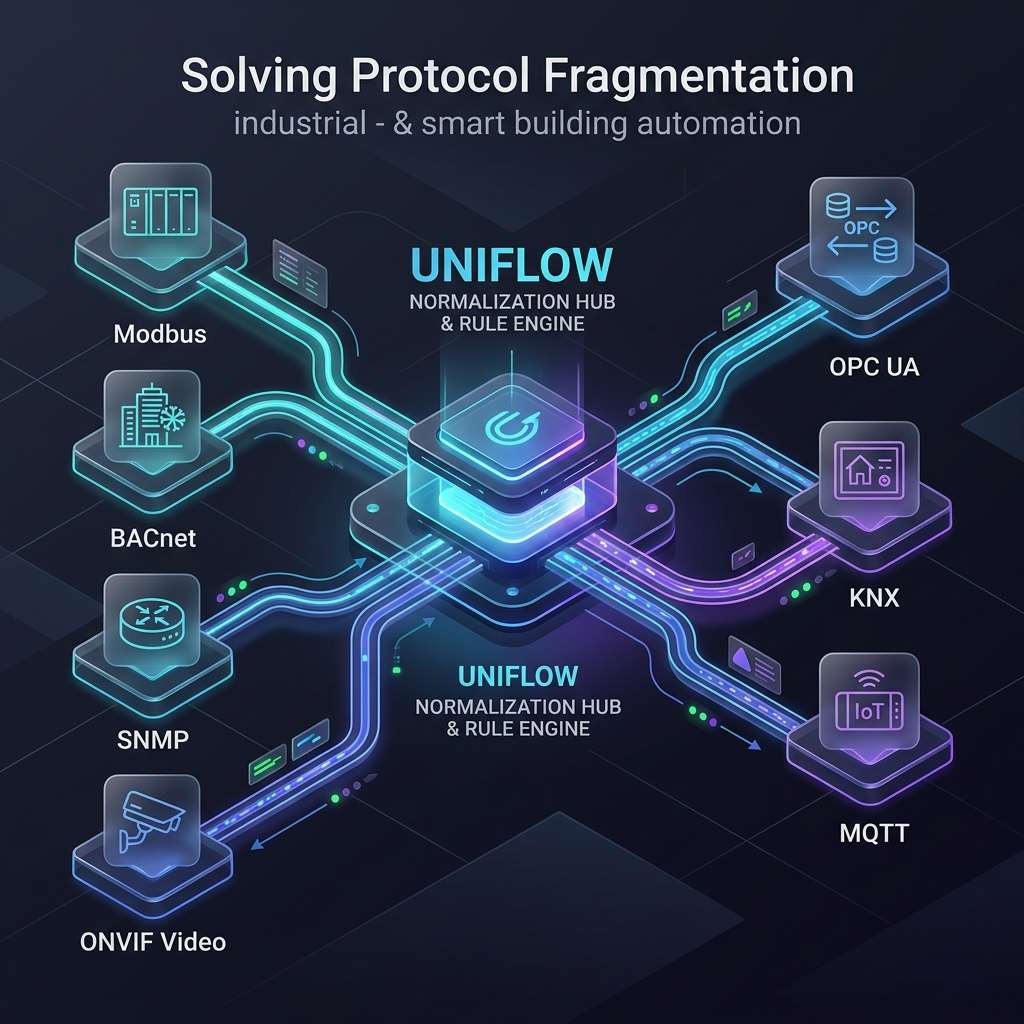
Uniflow utilizes a decoupled, independent client-server architecture powered by SignalR WebSockets to maximize operational stability, scalability, and multi-service management.
Headless background engine (.NET 8) handling protocol traffic, data normalization, internal tag storage, and priority rule execution. Supports multiple instances across hosts.
High-fidelity administration console for visual rule design, real-time topology health tracking, and remote service control.
High-speed bi-directional RPC command channel and real-time telemetry streaming over WebSockets, enabling seamless local or remote administration.
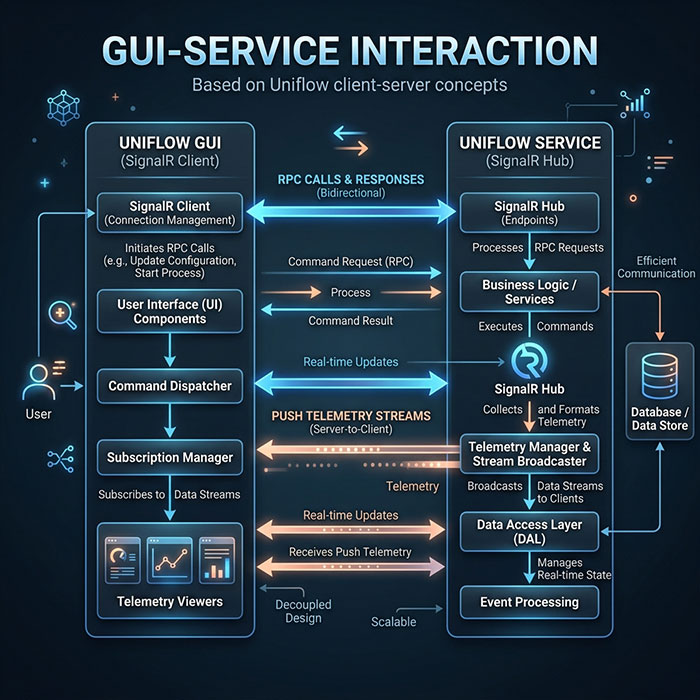
Because the interface is completely decoupled, a single independent GUI client can simultaneously connect to and manage multiple local or remote Uniflow Service instances.
Designed around dynamically isolated plugins, a global volatile tag hub, and a sub-millisecond rule coordinator.
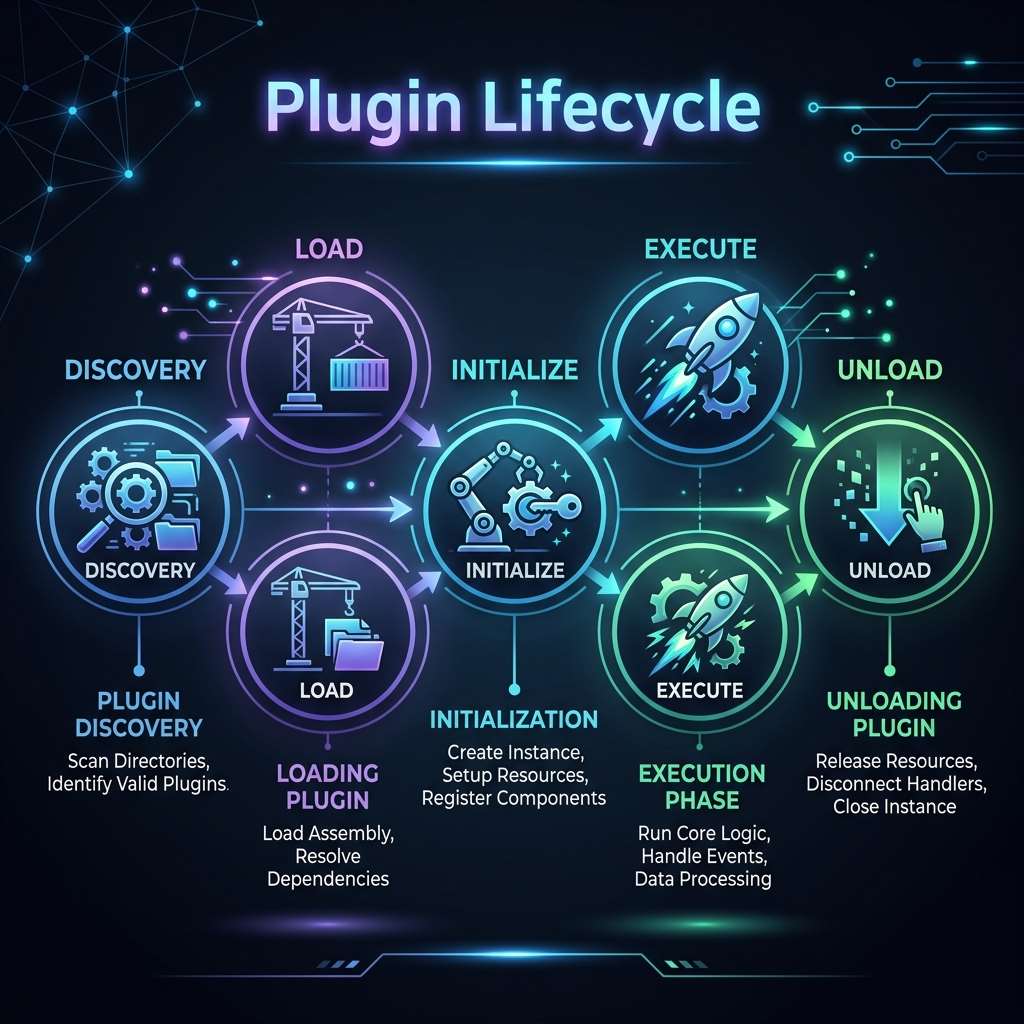
Uniflow leverages dynamically loaded plugins rather than a monolithic adapter layer. Each protocol (Modbus, OPC UA, SNMP, ONVIF, etc) operates as an isolated runtime extension that normalizes incoming telemetry into a unified contract.
An in-memory, ultra-fast volatile database acting as a common ground. Data from a Modbus PLC can be combined seamlessly with data from REST webhooks or SNMP monitoring agents into unified logic evaluation context.
Features built-in Loop Protection (trigger depth limits) to prevent cascading logic feedback loops, combined with sequential determinism and sub-millisecond execution snapshot tracing for visual debugging.
Native support for SNMP v3 (USM with SHA-256 & AES-256), OPC UA certificate sign/encrypt, and MQTT TLS 1.2/1.3 with X.509 client certificates.
Task-based parallelism ensures every protocol adapter executes its own asynchronous loop without blocking the main event coordinator or visual telemetry dispatch.
Adapters feature exponential backoff retry algorithms to seamlessly re-establish connection state during network drops or target reboot events.
Uniflow adapts seamlessly to edge gateways, central servers, security control centers, and cloud bridges.
Translates data in real time between incompatible industrial protocols without intermediate database persistence.
Gathers telemetry from dozens of disparate sources and exposes them via a single standardized master server.
Ingests Avigilon Control Center (ACC) analytics and SIA DC-09 intrusion alarm events to actuate industrial Modbus PLC relays, perimeter lights, and gate locks.
Translates SIA DC-09 alarm panel events and Modbus PLC sensor inputs directly into Milestone XProtect Smart Client alarms and camera PTZ preset triggers.
Collects high-speed local bus telemetry, applies signal conditioning algorithms, and streams clean data to the cloud.
Monitors IT server rack PDUs, environmental sensors, and UPS systems, logging state to enterprise SQL databases.